


2025 Volkswagen Atlas vs. 2025 Honda Pilot
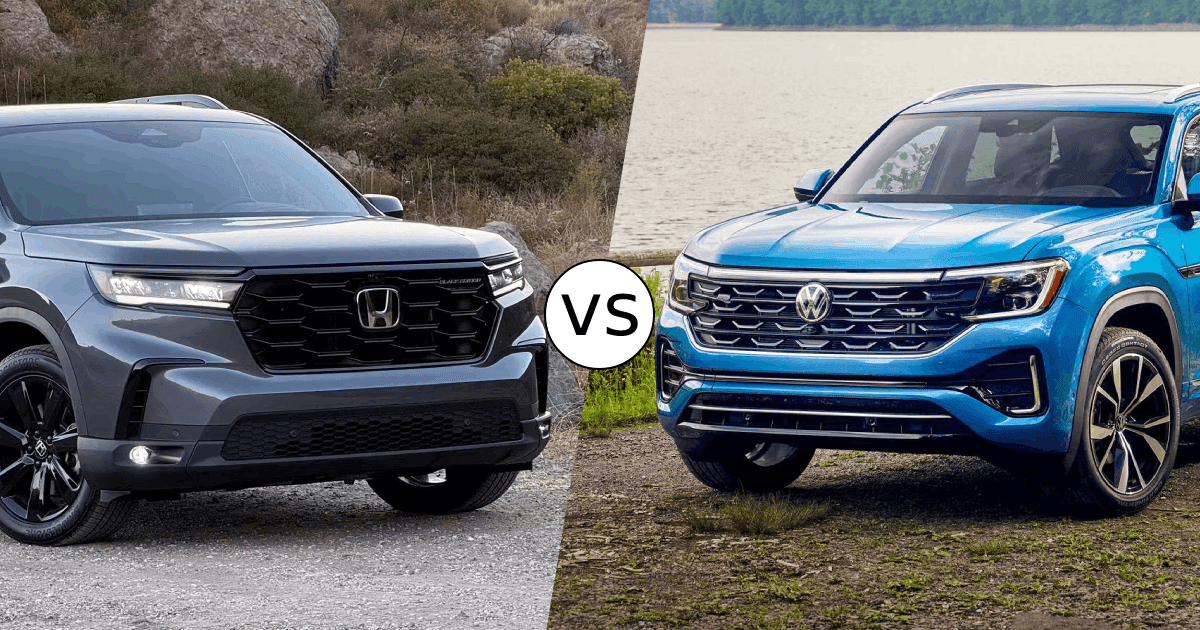
The 2025 Volkswagen Atlas is available in five trim levels: SE, SE with Technology, Peak Edition, SEL, and SEL Premium R-Line. With its bold styling and athletic stance, standard adaptive LED headlights, Volkswagen emblem, and an available illuminated grille, you’ll get noticed wherever you go. The starting MSRP for the Volkswagen Atlas SE is $38,200, rising to $53,205 for the top-of-the-range SEL Premium R-Line.
The 2025 Honda Pilot comes in Sport, EX-L, TrailSport, Touring, Elite, and Black Edition trim levels. It’s a good-looking SUV, but it has more conservative styling than the Atlas, except for the rugged TrailSport trim. The base Honda Pilot Sport starts with an MSRP of $40,200, while the Black Edition starts at $54,580.
Engine Performance and Fuel Economy
Volkswagen and Honda are known for their efficient and economical powertrains and the enjoyable handling characteristics of their vehicles. Let’s explore how the performance and driving dynamics of the Honda Pilot vs Volkswagen Atlas compare.
Engine Specifications and Transmission
The Atlas has a responsive turbocharged 2.0-liter four-cylinder engine that delivers 269 horsepower and 273 lb-ft of torque via an eight-speed automatic transmission. The Atlas SE and SE with Technology trims are offered with front-wheel drive (FWD) or all-wheel drive (AWD), while the other trims come standard with AWD. When properly equipped, the Atlas can tow up to 5,000 pounds.
The Pilot’s standard 3.5-liter V-6 engine makes a slightly higher 285 horsepower but a lower 262 lb-ft of torque, paired with a 10-speed automatic transmission. The lower three trims come standard with FWD and the option of AWD, while the top models have AWD as standard. FWD Pilots have a towing capacity of up to 3,500 pounds, while AWD models can tow up to 5,000 pounds.
Fuel Efficiency Ratings
The Atlas and Pilot have very similar EPA-estimated fuel economy ratings. With FWD, the Volkswagen Atlas gets up to 20 mpg on Clearwater city streets and 26 mpg when you head out on the highway. AWD models return up to 19 mpg in the city and 26 mpg on the highway. With FWD, the Pilot gets 19 mpg for city driving and 27 mpg on the highway. With AWD, you’ll still get 19 mpg in the city, but it drops slightly to 25 mpg for highway driving.
Driving Dynamics and Handling
The Volkswagen Atlas is surprisingly agile around town, and with its precise steering and impressive grip when cornering, it makes light work of Florida’s winding back roads. The transmission shifts quickly and smoothly, and the well-tuned suspension absorbs road imperfections without feeling as floaty as some of its rivals.
The Pilot’s V-6 makes all the right noises under acceleration, but it’s a little sluggish. The steering feels slightly imprecise and won’t give you much feel from the road. The transmission is overly keen to change gear, especially during city driving. However, the Pilot offers a smooth ride on uneven roads.
Interior Design and Comfort
When comparing the interior of the Volkswagen Atlas vs. the Honda Pilot, the Volkswagen has the upper hand, with a welcoming cabin and sophisticated, driver-centric cockpit.
Seating Capacity and Comfort Levels
The Volkswagen Atlas has seating for seven, or six with the available second-row captain’s chairs, and there’s ample space for adults in all three rows. The well-equipped base SE trim comes standard with synthetic leather upholstery, heated and ventilated power-adjustable front seats, a heated steering wheel, and tri-zone automatic climate control. Higher-spec trims offer leather seating, driver memory settings, massaging front seats, and a panoramic sunroof.
The Pilot can seat up to eight people, with roomy first and second rows, but the third row is a bit cramped. The Honda offers many desirable features, but you’ll need to splash out on a higher trim to get some of the equipment that’s standard in the Volkswagen Atlas.
Dashboard Layout and User Interface
The Atlas comes standard with a digital instrument display and a 12-inch infotainment touch screen that puts information and controls within easy reach. The infotainment system features wireless smartphone integration, USB ports in all rows, and a wireless charging pad. The Pilot Sport has a 7-inch touch screen and wired smartphone connectivity, but a 9-inch touch screen, wireless connectivity, and third-row USB ports are available on the EX-L trim.
Cargo Space
With a full complement of passengers, the Volkswagen Atlas has a generous 20.6 cubic feet of luggage space behind the rear seats. The second and third rows fold flat to give you a huge 96.6 cubic foot cargo area. The Honda Pilot has 18.6 cubic feet of cargo space with all seats in place, while folding the second and third rows gives you 87 cubic feet.
Which Three-Row SUV Is Right for Your Family?
We may be a little biased, but our team at Lokey Volkswagen in Clearwater, Florida, believes the 2025 Volkswagen Atlas comprehensively beats the 2025 Honda Pilot. It has a lower starting price, more standard equipment, and superior technology. Third-row passengers have more room, and the cargo area is larger. If you’re in the market for the ideal family vehicle, contact us today to schedule a test-drive of the Volkswagen Atlas and experience all of its family- and driver-friendly features.
0 comment(s) so far on 2025 Volkswagen Atlas vs. 2025 Honda Pilot